
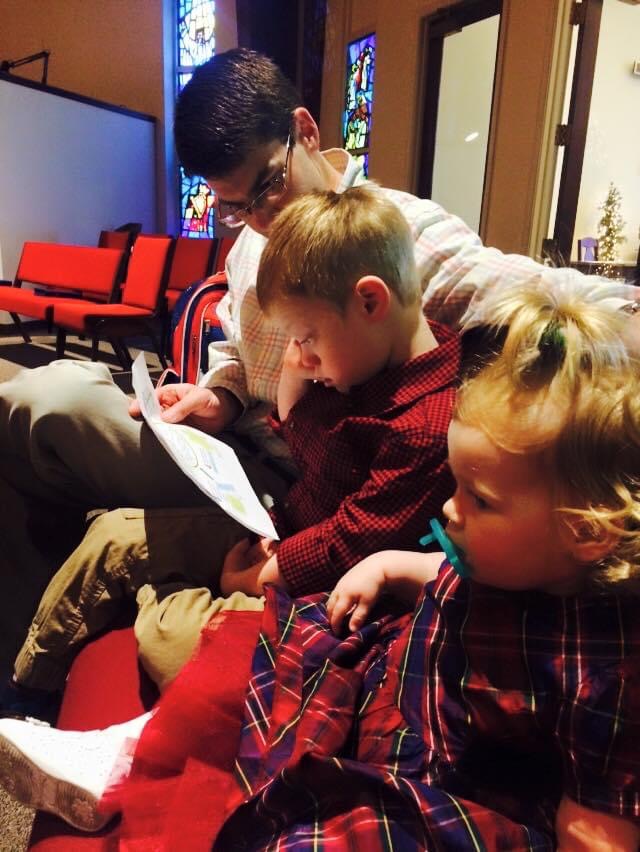
For years, my son was the boy in the back pew. The one that only fruit chews and endless fidgets and activities would get him through one-fourth of the service. Sunday mornings were often mentally and emotionally exhausting.
But the back pew is better than what church life (or lack thereof) looks like for many people with intellectual disabilities and their families.
The Experience of Church and Disability
In both my research and experience, families with children with disabilities have not historically been welcomed with open arms into faith communities. And even for those who are not turned away, the barriers created in many churches make the experience exhausting.
According to studies by Dr. Erik W. Carter, professor of special education at Vanderbilt University, and his colleagues, individuals with disabilities are less likely to attend worship services, Bible studies, and other church activities than those without. (1) If you want to dive deeper into the studies around church and disability, Dr. Stephen Grcevich, president and founder of Key Ministry, has compiled various studies on the topic.
In Matthew 19:14, Jesus said, ‘Let the little children come to me, and do not hinder them, for the kingdom of heaven belongs to such as these.’
I think it’s pretty simple; Jesus was about inclusion.
How Do You Come to a Point of Inclusion in a Faith Community?
And so we return to the boy in the back pew. When we moved to Maryland, we joined a Presbyterian church. During our first years of bumping around the back pew, I felt that it looked and seemed pointless at times.
It was my belief that both my children are fearfully and wonderfully made and deserve to be raised in a loving and inclusive faith tradition that fueled my desire to keep trying.
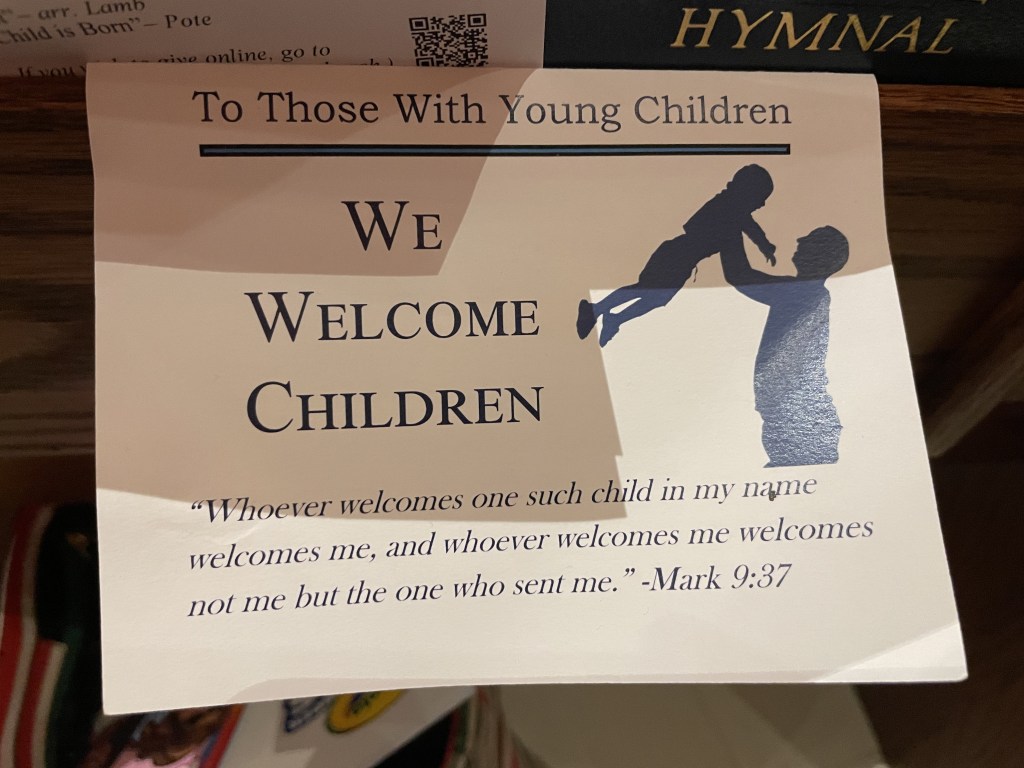
And so over several years, our son grew in maturity, and our church grew in mindset and practice around all children. We went from a church that sent children out of the sanctuary for the sermon and provided Sunday school in small and separate groups by age to a church that embraces children throughout the service, has a prayground for little ones who need to move during church, and hosts intergenerational Sunday school. It is a place where anyone and everyone who wants to be a part of a class, participate as a singer or musician, serve as an usher, and beyond is welcome to fully participate.
Over time, the Sundays got easier. I’d attribute it to his maturity and people creating a space where he was welcome and we were not judged.
A few years ago, that boy marched to the front pew one Sunday and sat down. His mom wasn’t completely sure, but we gave it a try. And somehow, now it feels like we’ve always sat there.
Since then, that boy has performed in the praise band, been in Christmas pageants, and ushered, but also gotten himself lost in the building for a search party to ensue. And the beauty of a true community of Christ is that I know our church family was here to be with us in all those experiences. They are here to celebrate our triumphant moments and support us in our challenging ones.
True Belonging
True inclusion takes supporting all families in authentic engagement in the life of the church. There is no roadmap, and it’s going to vary by individual, but some basic principles include:
-
- Presuming competence
-
- Seeing value in all people
-
- Talking to and developing a relationship with the individual
-
- Asking a family what they need
-
- Offering to sit with or watch the child when the caregiver needs a moment (and sometimes we do)
Authentic belonging is not tokenism. Belonging means that ministry is with and by all your members. This not only means attending but also serving, learning, and contributing. It’s not allowing the person with a disability to do a small task so that we can all feel inclusive. Not every person with a disability will want to speak, sing, or usher. It’s about engaging them in the life of the church that is meaningful to them and the work of God.
The Boy With the Light
This Christmas, the boy from the back pew helped his dad light the Christ candle while his sister and his mom read the Advent reading. And it wasn’t just a sweet moment where the teenager with Down syndrome got to light a candle. It was a joyful celebration of Christmas where a young man’s church family saw one of their own lighting that special candle. This is a young man they know ushers a few times a year, plays in the youth praise band, gives big hugs, loves all the babies of the church (sometimes following them around during their baptisms), is part of the confirmation class, and likes to drum with his markers during music selections.

The Christ candle represents the light that Jesus brought into the world when He was born. It reminds us that old things have passed away, all has been made new, and that Christ gives His light to everyone.
I believe God made my son uniquely able to light our lives in a way so few of us can. My hope is that more faith communities can embrace all people in the way Jesus intended.
References:
-
- Liu, Eleanor X; Carter, Erik W; Boehm, Thomas L; Annandale, Naomi H; Taylor, Courtney E. In Their Own Words: The Place of Faith in the Lives of Young People With Autism and Intellectual Disability. Intellectual and Developmental Disabilities52.5 (Oct 2014).
 inclusion AMPLIFIED
Leave a comment